Mountain Meadows Massacre
Under the Banner of HeavenThe Mountain Meadows Massacre was the killing of most of the Fancher emigrant party by Mormon militiamen and Paiute fighters in southern Utah in September 1857. Its significance lies not only in the deaths of roughly 120 travelers, but in the way an atmosphere of persecution, local authority, military deception, and an organized effort to conceal responsibility converged at Mountain Meadows. The account presents the massacre as an atrocity carried out by local Saints and Paiutes, not as a spontaneous clash or an attack by Indians alone.
Setting and causes
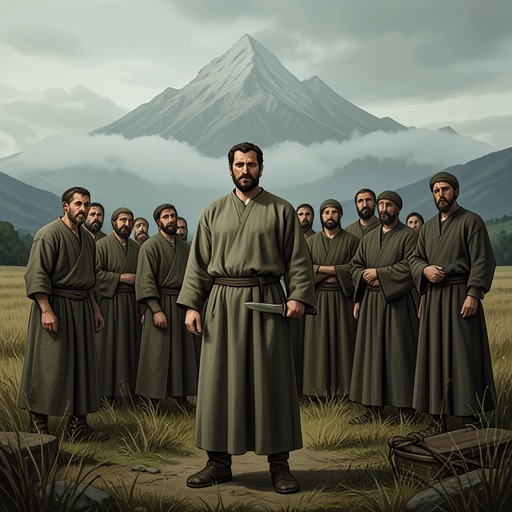
By the time the Fancher party reached the uplands of southern Utah, it had traveled about 280 miles beyond Salt Lake City. The wagon train included some 130 emigrants, mostly from Arkansas, around a thousand cattle, and two hundred horses. Apostate Mormons, known as backouts, had joined the group during its journey, bringing its total to approximately 140. The emigrants were traveling toward California along the Old Spanish Trail, and on the evening of September 6 they stopped beside a spring at Mountain Meadows, a green highland resting place before the route descended toward the Mojave Desert.
The party entered a territory already charged with hostility toward non-Mormon travelers. Church leaders had repeatedly recalled the persecution of Saints in Missouri and Illinois, including the killing of Joseph Smith and the expulsion from Nauvoo. Rumors that federal troops intended to hang Brigham Young and destroy the Mormon community intensified fears. By August, militias had been organized across Utah Territory, and Saints had been told not to sell provisions to emigrant trains. This remembered suffering helped bind the community together, but it also sharpened the boundary between Saints and outsiders and was used to encourage readiness for conflict. The history of persecution explains the atmosphere in which the Fancher party arrived; it does not excuse the attack on them.
Brigham Young’s meeting with Paiute chiefs in Salt Lake City on September 1 further shaped the immediate circumstances. According to the account, Young offered them the emigrants’ cattle and made clear that he wanted the Fancher train attacked. The Paiutes’ relations with the Saints were not those of dependable allies: they could be drawn into raids by promises of plunder, but did not simply share Mormon aims. When the Arkansans passed through Cedar City, Utah, on September 4 and asked to buy food, they were refused. False stories circulating there portrayed the emigrants as enemies responsible for earlier violence against Mormons.
The siege and surrender
John D. Lee later said that Isaac Haight, the mayor of Cedar City and commander of its local militia, ordered him to gather the Paiute chiefs, arm their warriors, and lead an ambush. Haight reportedly described the order as representing the will of those in authority. Lee and a force of Saints and Paiutes moved toward Mountain Meadows on September 5. They reached the hills above the emigrant camp the following day and prepared to attack. Some of the Mormon participants disguised themselves as Indians.
The assault began the next morning, as the emigrants were preparing breakfast. A child was struck by the first shot, and seven Arkansans were fatally wounded during the day. The travelers quickly formed their wagons into a defensive enclosure, dug in, and returned fire. Their resistance frustrated the attackers’ expectation of a quick victory. The initial attack developed into a siege lasting several days. Paiute participants gradually left, and by September 10 the Saints feared that they no longer had enough men to overcome the emigrants’ position by force.
The decision to end the standoff through deception followed further discussion among local leaders. Haight sought guidance from William Dame, the senior militia commander in southern Utah. Dame’s instruction, as relayed in the account, was that the emigrants should be killed. On September 11, Lee sent William Bateman, an English convert, toward the encampment under a white flag. Bateman represented the Mormons as offering to protect the travelers from the Paiutes and escort them to safety if they surrendered their weapons. Lee then entered the defensive position and negotiated. After prolonged uncertainty, the emigrants accepted the offer and gave up their arms.
The people were separated as they were led away from the encampment. The youngest children and some wounded travelers went in a wagon; women and older children followed on foot, while the men were escorted separately by Mormon guards. After about half an hour, John Higbee, a major in the Nauvoo Legion, gave the signal agreed upon in advance. The guards killed the men in their custody, and the women and children were attacked by Paiutes and by Saints disguised as Indians. The operation was coordinated: the promise of safe passage had disarmed the party and placed its members under the control of their escorts.
Deaths and immediate aftermath
The killing was over within minutes. An estimated 120 emigrants died: approximately fifty men, twenty women, and fifty children or adolescents. Seventeen people survived, all children no older than five. The account says the children were spared because they were considered too young to remember enough to testify against the Saints. Their survival did not undo the destruction of the party; it also left them as the only living witnesses from the emigrants who might later identify what had happened.
Afterward, Mormon participants took valuables from the dead, and the remaining property was left for the Paiutes. The distribution of the spoils was unequal: the Paiutes received relatively few animals, while Mormon officers claimed the best. In the poor settlements of southern Utah, the division created resentment and conflict among the Saints themselves. The massacre’s aftermath therefore included not only the attempt to conceal responsibility, but also disputes over the property taken from the victims.
The burial was hurried and inadequate. The dead were covered in shallow graves, and within days scavengers had disturbed the burial sites and scattered remains across the meadow. Dame and Haight arrived the morning after the killings. Lee later recalled that Dame appeared shaken when confronted with the scene, while Haight accused him of trying to evade responsibility for the order. The disagreement exposed a central feature of the crime: authority had been shared among local leaders, but the consequences now made each man’s part difficult to disclaim.
Concealment and historical significance
After the burial, the participants gathered and gave thanks for their victory over the emigrants. The overseers then insisted that the account of the massacre blame the Paiutes alone and deny Mormon involvement. They voted that anyone who disclosed who had been present or otherwise helped expose the truth should be killed. The cover story was thus not an incidental later distortion; according to the account, it was established immediately, alongside the threat used to enforce silence.
This episode belongs to a wider history in which remembered persecution could become a resource for collective identity and political mobilization. Earlier trials had been commemorated as proof of the Saints’ chosenness, and their recollection could reinforce confidence and solidarity. In the crisis of 1857, leaders repeatedly invoked those injuries while preparing the territory for conflict. The Oath of Vengeance, introduced into the temple endowment after Joseph Smith’s murder and the acquittal of his killers, also carried a promise to remember the deaths of church leaders across generations. That history provides context for the language of vengeance and communal loyalty in the book’s account, but it does not establish a direct chain of command from those earlier events to the massacre.
Mountain Meadows stands at the intersection of a defensive community’s persecution narrative and the lethal choices made by local men exercising religious and military authority. The effort to blame the Paiutes obscured the participation of Mormon settlers and the organized surrender scheme. The account’s sequence—from alarm and rumor, to siege, to promised protection, to coordinated killing and enforced secrecy—shows how violence could be prepared and concealed under the claims of communal danger and authority.